Eng 48B
2/20/09
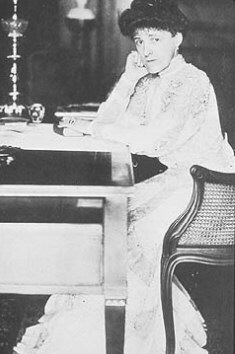
Edith Wharton Journal
“Having grown up in upper-class pre-World War I society, Wharton became one of its most astute critics. In such works as The House of Mirth and The Age of Innocence she employed both humor and profound empathy to describe the lives of New York's upper-class and the vanishing of their world in the early years of the 20th century.” (www.wikipedia.org)
As what can be described a psychological realist, Edith Wharton was very famous for her ability to use fictional characters in fictional stories to critique both the psychological underpinnings and the very moral fabric of, in particular, New York’s society. Having been raised in a rather wealthy family during the “golden era” of New York’s gentry of the time, Edith Wharton is rather strangely able to both satirize its very existence and yet lament its decline. Having culled much of her material from her very own experiences, Edith Wharton’s tales revolve very much around class and social levels, with a clear hierarchy being defined among the aristocracy. Almost just as fiercely present are the themes of feminine equality and the man’s role in society; Wharton frequently enjoying laughs at the men’s expense.
Having read “The Other Two” very recently, I was unfortunately brought back in time to my own rather embarrassing times during my high school years where I found myself jockeying to find a position in the social hierarchy of the aforementioned educational institution. After having made the time warp back to 2004, an age when people were still watching the “Chapelle Show” and Kramer from Seinfeld was still thought to be funny, it made me realize just how much of a social creature man is. It is often said that a person who lives alone in social isolation for extended periods of time eventually goes mad, but I can’t help but think that society itself is maddening. People are so enraptured with their own miniscule and unimportant lives that they fail to realize what life is truly about! Reading “The Other Two” made me both sweat in nervous fear and laugh out uncontrollably. This short story really highlights how we create our own problems and Wharton’s use of reality through prejudiced characters truly highlights the psychological zoo that our modern day lifestyle has promoted. People in school are more interested in fitting in than learning, and I say people because I don’t just mean kids up to high school. Even my fellow classmates in college have this very same mentality, one that dictates that image and role in school is more important than making it to class and learning. Having spent a couple of years at CSM, I find that there more so than at Foothill people are much more uptight and as such tend to project their “ideal self image” (ie – mask) much more so than Foothill students. Rather than be natural, it almost seems like CSM is a stage and every student is an actor whereas Foothill people are much more laid back and fun to talk to.